
How Much Does a Concrete Foundation Cost in Kentucky?
A new concrete foundation costs about $6 to $50 a square foot, one national cost guide reports. The type of foundation sets most of that range.
Under a 2,000 square foot home, that guide puts a slab on grade at $12,000 to $28,000. A full basement under the same home runs $70,000 to $100,000.
These are market numbers from published guides, not our price list. We pour concrete foundations and footings around Louisville, and every job gets a written quote.
What does a concrete foundation cost per square foot?
Cost guides price most foundation types by the square foot of the home. Poured walls go by the square foot of wall. These ranges come from one national cost guide, dated February 2026.
| Foundation type | Market range per square foot | 2,000 square foot home |
|---|---|---|
| Slab on grade | $6 to $14 | $12,000 to $28,000 |
| Stem wall | $6 to $18 | About $12,000 to $36,000 |
| Crawl space | $15 to $18 | $30,000 to $36,000 |
| Basement, unfinished | $35 to $50 | $70,000 to $100,000 |
| Poured concrete walls | $15 to $40 per square foot of wall | Priced by wall area |
The stem wall total is that range times 2,000 square feet. Most homeowners spend $52,000 to $100,000 on a full basement foundation, the guide adds. Its basement figures leave out finishing the inside.
A second national guide, labeled 2025 data, runs lower on basements, at $20 to $37 a square foot. It puts a slab foundation at about $5 to $16 and matches the first guide on stem walls. Treat any range as a starting point.
Foundation walls are either poured concrete or concrete block. Block foundation walls are a masonry contractor’s work, at $15 to $30 a square foot in the first guide.
What goes into the price of a foundation?
Cost guide prices for a foundation already include excavation, grading and footings. The first guide also prices some parts on their own.
| Price factor | Market figure | Kind of source |
|---|---|---|
| Labor | $3 to $7 per square foot, about half the cost | National cost guide, February 2026 |
| Concrete materials, slab foundation | $3 to $7 per square foot | Same guide |
| Rebar | Adds $1.40 to $4.00 per square foot | Same guide |
| Concrete delivery | Fees of $60 or more | Same guide |
| Excavation for a basement | $1,500 to $10,000 | Same guide |
| Grading for new construction | $1,000 to $5,000 | Same guide |
On a 2,000 square foot slab foundation, that labor rate comes to about $6,000 to $14,000. The second guide puts labor at 40 to 60 percent of the job.
Size and shape come next. Taller and thicker walls take more concrete. Step-downs and inside footings add labor and materials too.
Soil and rock move the price as well. Weak soil can call for more steel or deeper footings, the first guide notes. Buried rock ledges can push excavation past $50,000.
Equipment matters too. Concrete pumps and excavators add to the overall cost, the guide says. Our site grading page covers the dirt work around a new foundation.
What does Kentucky’s code require for footings?
The Kentucky Residential Code is the 2015 International Residential Code with Kentucky’s own amendments.
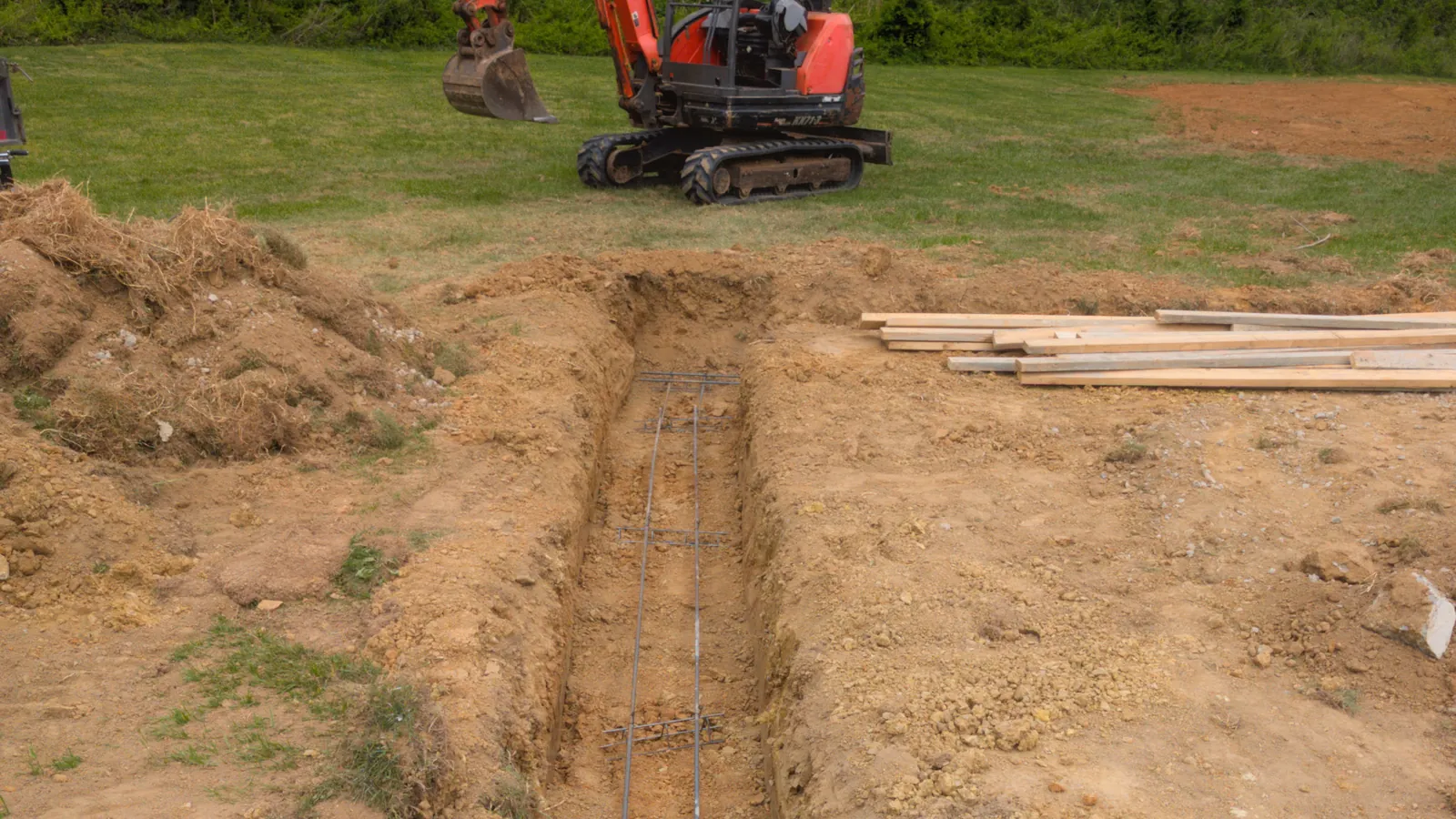
Kentucky’s code sends all exterior footings to the frost depth in its county table. That depth is 24 inches in most counties, Jefferson and Hardin included. It runs from the finished grade to the bottom of the footing.
A few counties go deeper, such as Boone and Kenton at 30 inches. If solid rock is exposed when the building pad is graded, footings may bear on the rock. They then need not reach the frost depth.
Soil sets the footing width. The model code bases that width on the soil’s load-bearing value. The state table rates clay and silt at half the load per square foot that gravel carries. Where weaker soil is likely, a soils investigation sets the number.
What does severe weathering mean for the concrete mix?
Kentucky’s code rates concrete weathering as severe in every county. That ties the mix to a strength table in the model code. Foundations not exposed to the weather need at least 2,500 psi, or pounds per square inch.
Foundation walls exposed to the weather need 3,000 psi and air-entrained concrete, with 5 to 7 percent air. Concrete that may freeze and thaw during construction gets air-entrained too. Higher strength mixes typically cost more, the first cost guide notes.
Which foundation fits a home, an addition or a garage?
For a house, the right type depends on the soil, the water level and the frost line, one guide says. A slab on grade costs the least and is the most common type. It suits level ground with stable soil.
A stem wall suits a sloped lot, since its sections can be built to different heights. A crawl space needs more digging and concrete perimeter walls. A basement puts the foundation below the frost line and adds living space, at the highest price.
An addition gets its own footings, dug to the same frost depth as a house. The plans show how the new foundation meets the old one. A national footing cost guide puts concrete footings at $5 to $18 per linear foot.
A detached garage or shop usually needs footings and a concrete slab floor. Its plans and the permit office set the details.
Kentucky’s code has its own section for post frame outbuildings, often called pole barns. Each post bears on a concrete footing in the soil.
A code table sizes each pier by building width: 18 inches across at 25 feet, 30 inches at 48 feet. That row assumes a 20 pound roof snow load. Each pier is at least half as thick as it is wide.
Deck and porch footings are concrete piers under the posts, sized and spaced to the plans. The state code exempts some small decks from a building permit. The limits include 200 square feet at most, 30 inches above grade at most and no attachment to the house.
Do you need a permit for a new foundation in Kentucky?
Kentucky’s code lists the work that needs no building permit. Sidewalks and driveways are on that list, and so are one-story sheds up to 200 square feet. A foundation is not. A new home, an addition or a garage usually goes under a building permit.
In Louisville Metro, the Division of Construction Review oversees new construction with plan review, permits and inspections. MSD, the Metropolitan Sewer District, reviews land disturbance in Jefferson County. Its single family permit, for erosion prevention and sediment control, typically covers new homes, most garages and additions.
Land disturbance over 2,000 square feet needs an MSD site disturbance permit. Outside Jefferson County, ask the city or county where the lot sits. Ask before any digging starts.
How do you get a real price for your foundation?
Every range above is a market number from published guides, not our price list. Your price comes from the plans, the soil, the depth and the access on your lot.
We pour footings and foundation walls around Louisville, plus the slab inside. We look at the plans and the site, then put the quote in writing. See how we pour concrete foundations, or call or text (502) 889-1624 for a free estimate.